Mostrando entradas con la etiqueta infografía. Mostrar todas las entradas
Mostrando entradas con la etiqueta infografía. Mostrar todas las entradas
jueves, 12 de octubre de 2023


martes, 7 de marzo de 2023
domingo, 3 de abril de 2022
Paneles solares.

Bourzac, Katherine. "Polymer Solar Cell espera reclamar un nuevo récord". C&EN, 23 de mayo de 2018.
Desjardins, Jeff. "Animación: Cómo funcionan los paneles solares". Visual Capitalist, 31 de enero de 2017.
Jacoby, Mitch. "Estabilización de células solares de perovskita". C&EN, 14 de octubre de 2018.
Instituto Fraunhofer de Sistemas de Energía Solar ISE. Informe fotovoltaico. (Friburgo: Instituto Fraunhofer para Sistemas de Energía Solar ISE, 24 de febrero de 2022).
Una colaboración entre C&EN y Andy Brunning, autor del popular blog de gráficos Compound Interest
Para ver más del trabajo de Brunning, vaya a compoundchem.com. Para ver todos los gráficos periódicos de C&EN, visite http://cenm.ag/periodicgraphics.
Fuente Gráficos periódicos: ¿Cómo funcionan los paneles solares? (acs.org)
jueves, 31 de marzo de 2022
Bunsen burner day

El quemador Bunsen es uno de los símbolos omnipresentes de la química. Aunque podría ser una vista más rara en los laboratorios universitarios en estos días, debido a algunas de las sustancias altamente inflamables utilizadas, todavía se encuentran muy comúnmente en las aulas de ciencias de la escuela, y para la mayoría de nosotros probablemente traen recuerdos de las lecciones de ciencias escolares.
Como hoy es el Día del Quemador Bunsen, este gráfico echa un vistazo rápido a la anatomía del quemador, y discutiremos su historia con un poco más de detalle a continuación.
En primer lugar, unas palabras sobre la elección de la fecha para el Bunsen Burner Day.
Esto coincide con el aniversario del nacimiento de su creador, Robert Bunsen, o, al menos, está destinado a hacerlo. En realidad, hay cierta confusión sobre la fecha de nacimiento de Bunsen, con algunos documentos que indican que de hecho es el 30 de marzo, mientras que otros afirman el 31. Aún más confuso, aunque su propio CV escrito a mano es uno de los documentos que da su fecha de nacimiento como el 30, su biógrafo afirmó que Bunsen comúnmente celebraba su cumpleaños el 31.
Aunque su fecha de nacimiento puede permanecer poco clara, la contribución de Bunsen a la ciencia en la forma de su desarrollo del quemador Bunsen está bien documentada. Su diseño en realidad se basó y desarrolló uno anterior creado por Michael Faraday, que él y su asistente de laboratorio Peter Desaga refinaron posteriormente. Bunsen quería crear un dispositivo que produjera una llama con muy poco hollín, un criterio que el quemador que él y Desaga diseñaron fue capaz de hacer.
Una llama de hollín arde de color amarillo o naranja; esto se debe a la presencia de átomos de carbono en el hollín, que brillan de color amarillo cuando se calientan a una temperatura alta.
Esto fue problemático para Bunsen, ya que quería estudiar los colores de la luz emitida cuando se calentaban diferentes elementos, pero esto era imposible con el color de los átomos de carbono incandescentes que enmascaraban cualquier otro color. Su nuevo quemador podría tener el flujo de aire en él ajustado.
Cuando se cerró su orificio de aire, se produjo una llama de hollín a baja temperatura debido a la quema incompleta del combustible de gas. Sin embargo, cuando el orificio de aire estaba abierto, más aire podía fluir hacia el quemador y, por lo tanto, había más oxígeno disponible, lo que permitía que el gas se quemara por completo y evitaba la generación de partículas de hollín.
Cuando una muestra de elemento se calienta, puede absorber energía de la llama, y los electrones en los átomos de la muestra pueden obtener esta energía: se convierten en lo que los químicos llaman "excitado", saltando a niveles más altos de energía electrónica dentro del átomo. Sin embargo, este es un estado fugaz. Los electrones pronto vuelven a caer a sus posiciones originales desde estos niveles de energía más altos.
Cuando lo hacen, liberan su exceso de energía en forma de luz, creando una emisión característica. El patrón exacto de luz producida en el espectro de emisión es único para diferentes elementos, esencialmente la "huella digital" de un elemento, por lo que se puede utilizar para determinar la identidad de un elemento.
Esto es exactamente lo que hizo Bunsen. Usando su quemador junto con un espectroscopio para permitirle ver las diferentes longitudes de onda de la luz emitida por muestras calentadas, pudo identificar los espectros de emisión de diferentes elementos.
Usando este proceso, incluso descubrió dos elementos previamente desconocidos: el cesio en 1860 y el rubidio en 1861. Los estudiantes comúnmente repiten un proceso similar usando su quemador epónimo en las escuelas de hoy.
Los compuestos sólidos se pueden mantener en una llama Bunsen, o las soluciones se pueden rociar en la llama, para producir llamas de colores que son características de elementos particulares, lo que permite identificarlos.
Los espectros de emisión de los elementos tampoco solo tienen aplicaciones en el laboratorio de ciencias.
También son utilizados por los astrónomos para identificar los constituyentes elementales de estrellas distantes. Sin poder interpretar estos espectros, sería casi imposible determinar los constituyentes de las estrellas, pero con ellos, podemos determinar con confianza la composición de las estrellas a cientos de años luz de distancia.
domingo, 27 de marzo de 2022
Crocus chemistry: Saffron, colours, and poisonous imposters

Did you know that saffron is obtained from a type of crocus? This is a fact that had somehow escaped me, and which I only discovered when wondering why saffron contains a compound called ‘crocin’. Turns out that, yes, there is a connection!
While the idea for this infographic was prompted by the eruption of crocuses currently taking place in our garden, these are Crocus vernus, the spring crocus. The crocus from which saffron is obtained is commonly called the saffron crocus, or sometimes the autumn crocus (more on that alternative later). As the latter name suggests, the saffron crocus, Crocus sativus, flowers in the autumn.
Saffron is obtained from the crocus stigmas, three deep red tendrils protruding from the centre of each flower. It takes a colossal 150 crocus flowers to produce a single gram of dried saffron, which goes a long way towards explaining why it’s the most expensive spice on supermarket shelves. Saffron’s deep red colour is due to the presence of crocin, a compound derived from the carotenoid compound crocetin. Crocin and related compounds are found in other crocuses, too, contributing to the range of yellows and oranges.
The purples and lilacs of crocus petals are due to a different group of compounds: anthocyanins. Researchers have identified nine key anthocyanin compounds as contributing to crocus colour, mainly glucosides of delphinidin and petunidin. They also identified some malonated anthocyanins which appear to be completely unique to crocuses.
While the crocus from which saffron is derived is sometimes referred to as “autumn crocus”, this moniker has the potential for deadly confusion. “Autumn crocus” is also commonly used as a name for several species in the Colchicum genus. These plants can look very similar to the saffron crocus, and also flower during the autumn, but you definitely don’t want to harvest any parts of them – all parts of the plant contain the toxic alkaloid colchicine.
Justin Brower over at Nature’s Poisons has a great post on colchicine, where he goes into the mechanism behind its toxicity:
Colchicine has two modes of action in the body. In the first, colchicine inhibits neutrophil activity. These are a type of white blood cell that kicks into gear during an immune response, causing inflammation. […] The second mode of action is by binding to tubulin, which in turn inhibits mitosis […] the process in the cell cycle in which the chromosomes are split into two identical daughter cells. We need mitosis for growth and replacement.
Colchicine: Don’t Eat the Crocus – Nature’s Poisons
Eating colchicine can lead to all manner of unpleasant symptoms, and more seriously can result in multiple organ failure and death. In short, you really don’t want to get autumn crocuses confused.
Despite its toxicity, colchicine has also been used as a treatment for gout due to its anti-inflammatory properties – usually when patients can’t take more standard anti-inflammatory painkillers. It’s another classic case of the dose making the poison, albeit one where there’s not a huge degree of difference: the dose required for therapeutic effects is not hugely distant from the dose at which toxicity is seen.
The good news is that true crocuses don’t contain colchicine. While eating bits of them still isn’t recommended – they still contain other compounds which, though they may not kill you, are still more than capable of kicking off unpleasant symptoms – saffron itself is safe to eat. Considering how many crocus plants it takes to make it, you’re probably still best off buying it at the supermarket.
The graphic in this article is licensed under a Creative Commons Attribution-NonCommercial-NoDerivatives 4.0 International License. See the site’s content usage guidelines.
Información obtenida de https://www.compoundchem.com/2022/03/15/crocus/
lunes, 21 de marzo de 2022
How do plant milks compare to cow’s milk?

For plant milk manufacturers, business is booming. In 2021, 32% of British people surveyed drank plant-based milk as part of their diet, compared to 25% in 2020. How are these milks made, and how do they compare to cow’s milk when it comes to their environmental impact and nutritional value? This graphic takes a look.
The graphic in this article is licensed under a Creative Commons Attribution-NonCommercial-NoDerivatives 4.0 International License. See the site’s content usage guidelines.
Información sacada de https://www.compoundchem.com/2022/01/11/plant-milk/
miércoles, 29 de diciembre de 2021
Un salto de genes de planta a mosca
Esta es la historia de cómo un gen de autodefensa pasó de un vegetal a una mosca, lo que ahora le permite ser una plaga inmune a pesticidas naturales. Este paso de ADN a compañeros del entorno es el primer caso de transferencia genética horizontal que se observa entre un vegetal y un animal complejo, y que funciona.
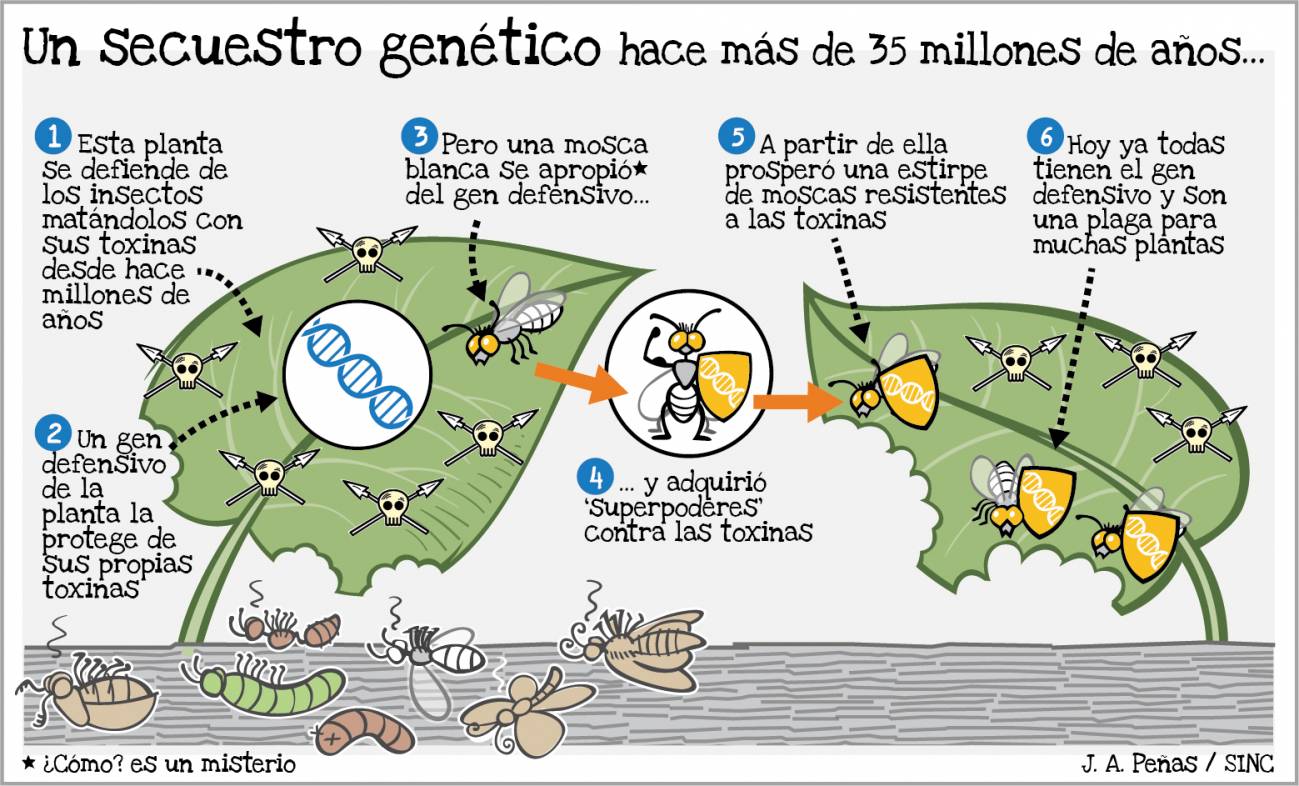
La mosca que adquirió un gen de una planta.
Esta es la historia de cómo un gen de autodefensa pasó de un vegetal a una mosca, lo que ahora le permite ser una plaga inmune a pesticidas naturales. Este paso de ADN a compañeros del entorno es el primer caso de transferencia genética horizontal que se observa entre un vegetal y un animal complejo, y que funciona.
Hace algo más de 35 millones de años tuvo lugar un secuestro genético determinante e inusual. De alguna manera, un gen de autodefensa de una planta pasó al interior celular de una mosca blanca. Una vez dentro, allí se quedó y desde allí se heredó hasta que a todas ellas se extendió. Desde entonces, la mosca blanca usa su función como escudo y es capaz de resistir los ataques que muchas plantas lanzan contra toda suerte de insectos. Hoy, y en virtud de ese gen, la mosca blanca es una de las plagas más destructivas del mundo.
Toda su historia, en este reportaje.
Fuente:
SINC
Derechos: Creative Commons
jueves, 23 de diciembre de 2021
La pandemia no acaba en Navidad
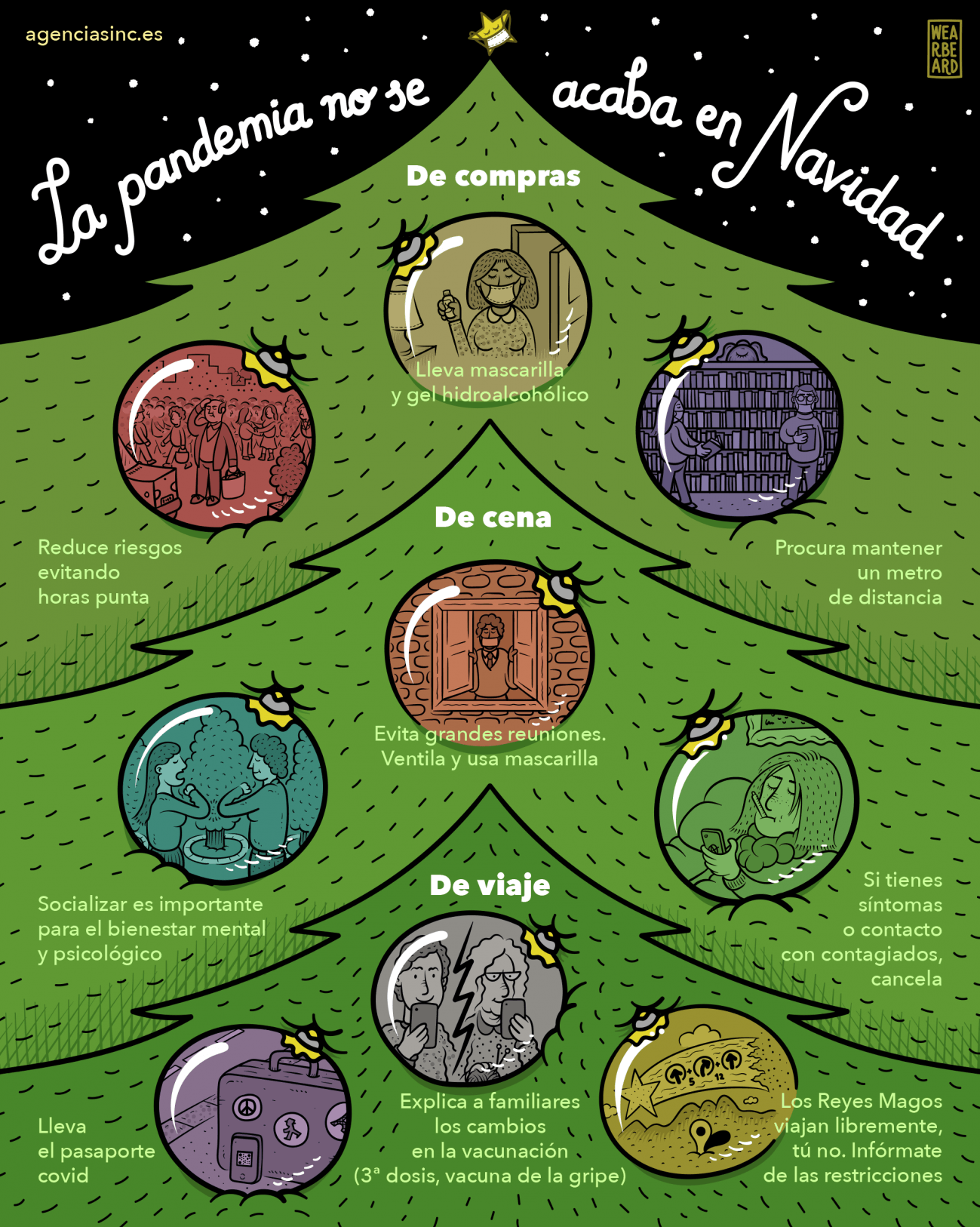
Las celebraciones de esta Navidad ya han comenzado con las comidas, cenas y reuniones con compañeros y compañeras de trabajo y amistades. En esta época de fiestas, con una tendencia al alza de los contagios por covid-19 en todas las comunidades autónomas, no debemos olvidar las medidas de seguridad frente al virus.
Aunque España sea de los países con menos restricciones actualmente, son momentos de numerosos contactos. Limitar el número de personas en estas reuniones y evitar grandes concentraciones de gente es fundamental. También lo es continuar con el lavado de manos frecuente, mantener las distancias, llevar mascarilla y estar informado de todas las novedades de vacunación, así como de los cambios en los requisitos de entrada y salida en los diferentes países si se va a viajar.
Encontrarse con nuestros seres queridos es importante para nuestro bienestar psicológico y personal. Hagámoslo con responsabilidad. ¡Felices Fiestas!
Fuente Sinc (agenciasinc.es)
domingo, 28 de febrero de 2021

sábado, 2 de septiembre de 2017
lunes, 28 de agosto de 2017
martes, 25 de julio de 2017
miércoles, 12 de julio de 2017
The smell of garbage.

miércoles, 2 de noviembre de 2016

miércoles, 7 de septiembre de 2016
domingo, 4 de septiembre de 2016

lunes, 4 de julio de 2016

viernes, 3 de junio de 2016

lunes, 23 de mayo de 2016

jueves, 5 de mayo de 2016

Suscribirse a:
Entradas (Atom)