Mostrando entradas con la etiqueta química. Mostrar todas las entradas

miércoles, 22 de octubre de 2025

Premio Nobel de Química 2025


Su arquitectura molecular contiene espacios para la química.

Los ganadores del Premio Nobel de Química 2025 han creado estructuras moleculares con amplios espacios por los que pueden fluir gases y otras sustancias químicas. Estas estructuras, estructuras metalorgánicas , pueden utilizarse para extraer agua del aire del desierto, capturar dióxido de carbono, almacenar gases tóxicos o catalizar reacciones químicas.


Susumu Kitagawa , Richard Robson y Omar Yaghi recibieron el Premio Nobel de Química 2025. Desarrollaron una nueva forma de arquitectura molecular. En sus estructuras, los iones metálicos funcionan como pilares unidos por largas moléculas orgánicas (carbonadas). Juntos, los iones y moléculas metálicas se organizan para formar cristales con grandes cavidades. Estos materiales porosos se denominan estructuras metalorgánicas (MOF). Al variar los componentes básicos de las MOF, los químicos pueden diseñarlas para capturar y almacenar sustancias específicas. Las MOF también pueden impulsar reacciones químicas o conducir electricidad.

“Las estructuras metalorgánicas tienen un potencial enorme y brindan oportunidades nunca antes previstas para materiales hechos a medida con nuevas funciones”, afirma Heiner Linke, presidente del Comité Nobel de Química.

Todo comenzó en 1989, cuando Richard Robson experimentó con el uso de las propiedades inherentes de los átomos de una forma novedosa. Combinó iones de cobre con carga positiva con una molécula de cuatro brazos; esta tenía un grupo químico que era atraído por los iones de cobre en el extremo de cada brazo.

Al combinarse, se unieron para formar un cristal amplio y ordenado. Era como un diamante lleno de innumerables cavidades.

Robson reconoció de inmediato el potencial de su construcción molecular, pero era inestable y colapsaba con facilidad. Sin embargo, Susumu Kitagawa y Omar Yaghi sentaron bases sólidas para este método de construcción; entre 1992 y 2003, realizaron, por separado, una serie de descubrimientos revolucionarios. Kitagawa demostró que los gases pueden fluir dentro y fuera de las construcciones y predijo que los MOF podrían hacerse flexibles. Yaghi creó un MOF muy estable y demostró que puede modificarse mediante un diseño racional, dotándolo de propiedades nuevas y deseables.

Tras los revolucionarios descubrimientos de los galardonados, los químicos han construido decenas de miles de MOF diferentes. Algunos de ellos podrían contribuir a resolver algunos de los mayores desafíos de la humanidad, con aplicaciones que incluyen la separación de PFAS del agua, la descomposición de trazas de fármacos en el medio ambiente, la captura de dióxido de carbono o la recolección de agua del aire del desierto.


Susumu Kitagawa , nacido en 1951 en Kioto, Japón. Doctorado en 1979 por la Universidad de Kioto, Japón. Profesor de la Universidad de Kioto, Japón.

Richard Robson , nacido en 1937 en Glusburn, Reino Unido. Doctor en 1962 por la Universidad de Oxford, Reino Unido. Profesor de la Universidad de Melbourne, Australia.

Omar M. Yaghi , nacido en 1965 en Ammán, Jordania. Doctorado en 1990 por la Universidad de Illinois en Urbana-Champaign, EE. UU. Profesor de la Universidad de California, Berkeley, EE. UU.

jueves, 31 de marzo de 2022

Bunsen burner day


 El quemador Bunsen es uno de los símbolos omnipresentes de la química. Aunque podría ser una vista más rara en los laboratorios universitarios en estos días, debido a algunas de las sustancias altamente inflamables utilizadas, todavía se encuentran muy comúnmente en las aulas de ciencias de la escuela, y para la mayoría de nosotros probablemente traen recuerdos de las lecciones de ciencias escolares. 

Como hoy es el Día del Quemador Bunsen, este gráfico echa un vistazo rápido a la anatomía del quemador, y discutiremos su historia con un poco más de detalle a continuación.   En primer lugar, unas palabras sobre la elección de la fecha para el Bunsen Burner Day. 

Esto coincide con el aniversario del nacimiento de su creador, Robert Bunsen, o, al menos, está destinado a hacerlo. En realidad, hay cierta confusión sobre la fecha de nacimiento de Bunsen, con algunos documentos que indican que de hecho es el 30 de marzo, mientras que otros afirman el 31. Aún más confuso, aunque su propio CV escrito a mano es uno de los documentos que da su fecha de nacimiento como el 30, su biógrafo afirmó que Bunsen comúnmente celebraba su cumpleaños el 31. 

 Aunque su fecha de nacimiento puede permanecer poco clara, la contribución de Bunsen a la ciencia en la forma de su desarrollo del quemador Bunsen está bien documentada. Su diseño en realidad se basó y desarrolló uno anterior creado por Michael Faraday, que él y su asistente de laboratorio Peter Desaga refinaron posteriormente. Bunsen quería crear un dispositivo que produjera una llama con muy poco hollín, un criterio que el quemador que él y Desaga diseñaron fue capaz de hacer. Una llama de hollín arde de color amarillo o naranja; esto se debe a la presencia de átomos de carbono en el hollín, que brillan de color amarillo cuando se calientan a una temperatura alta.

 Esto fue problemático para Bunsen, ya que quería estudiar los colores de la luz emitida cuando se calentaban diferentes elementos, pero esto era imposible con el color de los átomos de carbono incandescentes que enmascaraban cualquier otro color. Su nuevo quemador podría tener el flujo de aire en él ajustado. 

Cuando se cerró su orificio de aire, se produjo una llama de hollín a baja temperatura debido a la quema incompleta del combustible de gas. Sin embargo, cuando el orificio de aire estaba abierto, más aire podía fluir hacia el quemador y, por lo tanto, había más oxígeno disponible, lo que permitía que el gas se quemara por completo y evitaba la generación de partículas de hollín. 

 Cuando una muestra de elemento se calienta, puede absorber energía de la llama, y los electrones en los átomos de la muestra pueden obtener esta energía: se convierten en lo que los químicos llaman "excitado", saltando a niveles más altos de energía electrónica dentro del átomo. Sin embargo, este es un estado fugaz. Los electrones pronto vuelven a caer a sus posiciones originales desde estos niveles de energía más altos. 

Cuando lo hacen, liberan su exceso de energía en forma de luz, creando una emisión característica. El patrón exacto de luz producida en el espectro de emisión es único para diferentes elementos, esencialmente la "huella digital" de un elemento, por lo que se puede utilizar para determinar la identidad de un elemento. 

 Esto es exactamente lo que hizo Bunsen. Usando su quemador junto con un espectroscopio para permitirle ver las diferentes longitudes de onda de la luz emitida por muestras calentadas, pudo identificar los espectros de emisión de diferentes elementos. 

Usando este proceso, incluso descubrió dos elementos previamente desconocidos: el cesio en 1860 y el rubidio en 1861. Los estudiantes comúnmente repiten un proceso similar usando su quemador epónimo en las escuelas de hoy. 

Los compuestos sólidos se pueden mantener en una llama Bunsen, o las soluciones se pueden rociar en la llama, para producir llamas de colores que son características de elementos particulares, lo que permite identificarlos. 

 Los espectros de emisión de los elementos tampoco solo tienen aplicaciones en el laboratorio de ciencias. 

También son utilizados por los astrónomos para identificar los constituyentes elementales de estrellas distantes. Sin poder interpretar estos espectros, sería casi imposible determinar los constituyentes de las estrellas, pero con ellos, podemos determinar con confianza la composición de las estrellas a cientos de años luz de distancia. 

miércoles, 23 de marzo de 2022

International Women’s Day: Twelve women from chemistry history


 Today (8 March) is International Women’s Day, so here’s another edition of the ‘Women in Chemistry History’ series. It highlights the contributions of another 12 women in chemistry, covering innovations from understanding cell ageing to testing for diseases.

If you haven’t seen the previous editions of this series, they’re available here: Part 1, part 2, and part 3. There’s also an edition looking at contemporary women in chemistry, and a graphic looking at the women of the periodic table. Additionally, there’s the mammoth ongoing project to highlight contemporary women in chemistry which currently features 170 entries and counting!

The text of this graphic is reproduced below for screenreaders.

Rona Robinson (1884-1962)
The first woman in the UK to gain a first-class degree in chemistry. She later carried out research on dyes and was also a campaigner for women’s suffrage.

Rebeca Gerschman (1903-1986)
The first scientist to suggest that oxygen free radicals damage cells and cause cell ageing. She was nominated for a Nobel Prize but died before being considered.

Ruby Hirose (1904-1960)
Carried out research on serums and antitoxins. Her work contributed to the development of an effective polio vaccine, leading to its near-eradication.

Mary Elliott Hill (1907-1969)
Thought to be the first African American woman to be awarded a master’s degree in chemistry. With her husband, Carl McClellan Hill, developed ketene synthesis.

Mildred Cohn (1913-2009)
Used nuclear magnetic resonance to study the reactions of enzymes and proteins in the human body, particularly focusing on the reactions of ATP.

Asima Chatterjee (1917-2006)
The first woman to receive a doctorate at an Indian university. Carried out research on plant-derived medicines, leading to anti-epileptic and anti-malarial drugs.

Katsuko Saruhashi (1920-2007)
Carried out research showing that seawater releases more carbon dioxide than it absorbs, and also identified radioactive isotopes in seawater due to nuclear testing.

Helen Murray Free (1923-2021)
Worked on the development of test strips for diseases, including urine analysis ‘dip and read’ test strips for UTIs, diabetes and kidney disorders.

Evangelina Villegas (1924-2017)
Worked with Surinder Vasal to improve the amino acid content of maize, making it more nutritious. They were awarded the World Food Prize for their work.

Alma Levant Hayden (1927-1967)
Amongst the first African American scientists to work at the US Food & Drug Administration, where she uncovered Krebiozen as a sham cancer treatment.

Bettye Washington Greene (1935-1995)
Researched latex and polymers at Dow Chemical, which led to several patents. She was the first black woman to work in a professional position at the company.

Margarita Salas (1935-2019)
Discovered an enzyme which can amplify DNA samples, making them large enough for analysis, with important applications in forensics and medical testing.

The graphic in this article is licensed under a  Creative Commons Attribution-NonCommercial-NoDerivatives 4.0 International License. See the site’s content usage guidelines.

Información obtenida de https://www.compoundchem.com/2022/03/08/iwd2022/

lunes, 21 de marzo de 2022

How do plant milks compare to cow’s milk?


 For plant milk manufacturers, business is booming. In 2021, 32% of British people surveyed drank plant-based milk as part of their diet, compared to 25% in 2020. How are these milks made, and how do they compare to cow’s milk when it comes to their environmental impact and nutritional value? This graphic takes a look.

The graphic in this article is licensed under a  Creative Commons Attribution-NonCommercial-NoDerivatives 4.0 International License. See the site’s content usage guidelines.

Información sacada de https://www.compoundchem.com/2022/01/11/plant-milk/

domingo, 20 de marzo de 2022

The year in chemistry 2021


https://i0.wp.com/www.compoundchem.com/wp-content/uploads/2022/01/Chemistry-News-2021-Year-in-Review-v2.png?ssl=1

In 2020, science news was dominated by COVID and vaccine development. In many ways, 2021 has been little different, but away from the virus we’re now overly familiar with there were plenty of other chemistry-related news stories. This graphic highlights a selection of them – see below for more details as well as links to related articles and studies.

  1. Development of antivirals for COVID-19
    2021’s undoubted success story was the rollout of vaccines which brought us back to some semblance of normality. But development and trials of antivirals against COVID-19 also continued apace. A significant story was that of Molnupiravir, an antiviral pill initially hailed as a potent weapon against the disease. While full trial data has shown a lower effectiveness for Molnupiravir which has tempered some of the initial enthusiasm, it may still be beneficial. Another drug, Paxlovid, has been recently approved in the USA and UK and showed 89% efficacy in patients at risk of serious illness. However, producing sufficient Paxlovid to meet demand is likely to pose a challenge.
  2. Highly fluorinated compound restrictions
    Concerns around the use of per- and polyfluoroalkyl substances (commonly referred to as PFAS) have been growing over the past few years, particularly in relation to their potential toxicity and persistence in the environment. Their strong carbon-fluorine bonds resist being broken down by most means. In July, the US state of Maine became the first government to ban the use of PFAS where alternatives are available, and the EU also took steps towards potential future restrictions.
  3. Asymmetric organocatalysis wins chemistry Nobel Prize
    The Nobel Prize in Chemistry was awarded to Benjamin List and David MacMillan for developing asymmetric organocatalysis, which uses organic compounds to catalyse the creation of mirror image molecules.
  4. Use of leaded fuel finally phased out worldwide
    Leaded petrol, invented in 1921, was finally phased out 100 years later. Though its sale has been banned in many countries for some time, in July, Algeria became the last country in the world to halt sale of leaded petrol. The lead from leaded petrol will still be with us for some time, however; a study in June this year found that airborne particles in London still have 
    much higher levels of lead than the usual background level, 22 years after leaded petrol was banned in the UK.
  5. Amine catalysis claim debunked
    Early in the year, the chemistry world was abuzz with the publication of a study claiming that a carbon-carbon bond-forming reaction could be catalysed by an amine compound, instead of the usual expensive palladium catalyst. By the end of the year, however, the claims had been conclusively debunked. The observed catalytic activity was not, in fact, due to the amine, but due to the accidental creation of a palladium complex during the preparation of the amine.
  6. AI predicts protein structures
    AlphaFold, an AI tool produced by DeepMind (itself part of the the same company as Google) this year produced predicted protein structures for the nearly 20,000 proteins made by the human body. Proteins are built up from amino acids, and while determining the sequence of amino acids is relatively straightforward, predicting how the resultant protein chain arranges itself in 3D space is much more challenging. The structures have been made available for free online, and could give insights into protein function, as well a offering potential new targets for drug design.
  7. First malaria vaccine approved
    In October, the World Health Organisation approved the first vaccine for malaria in children. As well as being the first vaccine for malaria, it’s the first vaccine to be approved for any parasitic disease. The vaccine’s effectiveness is modest – it requires four doses, and prevents 30% of severe malaria cases in children under 5 – but it’s still estimated it could prevent the deaths of 23,000 children every year.
  8. Researchers create metallic water
    By dripping a liquid sodium-potassium alloy into a vacuum chamber containing small amounts of water vapour, researchers were able to observe metallic water, formed as electrons from the alloy were drawn into the water. Previously, metallic water’s existence had been theorised to occur only at extremely high pressures.
  9. Making jet fuel from captured carbon dioxide
    In November, details of a rooftop refinery which can convert carbon dioxide and water vapour from the air into jet fuel were published. The reactor uses a solar-powered redox reactor to reduce the carbon dioxide and water vapour to carbon monoxide and hydrogen, from which hydrocarbon fuels can be made. Commercialisation is planned, though an area a little larger than Switzerland would be required to meet current global aviation fuel demands.
  10. Controversial Alzheimer’s drug approved
    You might have thought that the first new approval of a drug for Alzheimer’s disease in 20 years might be a cause for fanfare. However, the drug in question, Aduhelm, which reduces amyloid-β plaques in the brain, has been met with scepticism about its effectiveness and cost – and questions remain over whether it slows cognitive decline. Despite its approval in the USA back in June, uptake of the drug has so far been limited.
  11. Skin oil changes identify Parkinson’s
    Several years ago, Joy Milne was dubbed “the woman who can smell Parkinson’s” after detecting a change in her husband’s smell years before he was diagnosed with the condition, and subsequently detecting a similar smell from other Parkinson’s sufferers. This year, research published in March identified 10 skin lipids that differed significantly between those with Parkinson’s and those without. It could help with diagnosis and monitoring the progression of the disease in sufferers.
  12. Home weed killers phase out glyphosate
    Glyphosate herbicides won’t be sold for home use in the US from 2023. The move follows concern about glyphosate’s effects on health, though the company that sells it, Bayer, says it’s primarily to avoid litigation. Glyphosate’s agricultural use will continue.

The graphic in this article is licensed under a  Creative Commons Attribution-NonCommercial-NoDerivatives 4.0 International License. See the site’s content usage guidelines.

Informacion de https://www.compoundchem.com/2021/12/30/tyic2021/

sábado, 9 de octubre de 2021

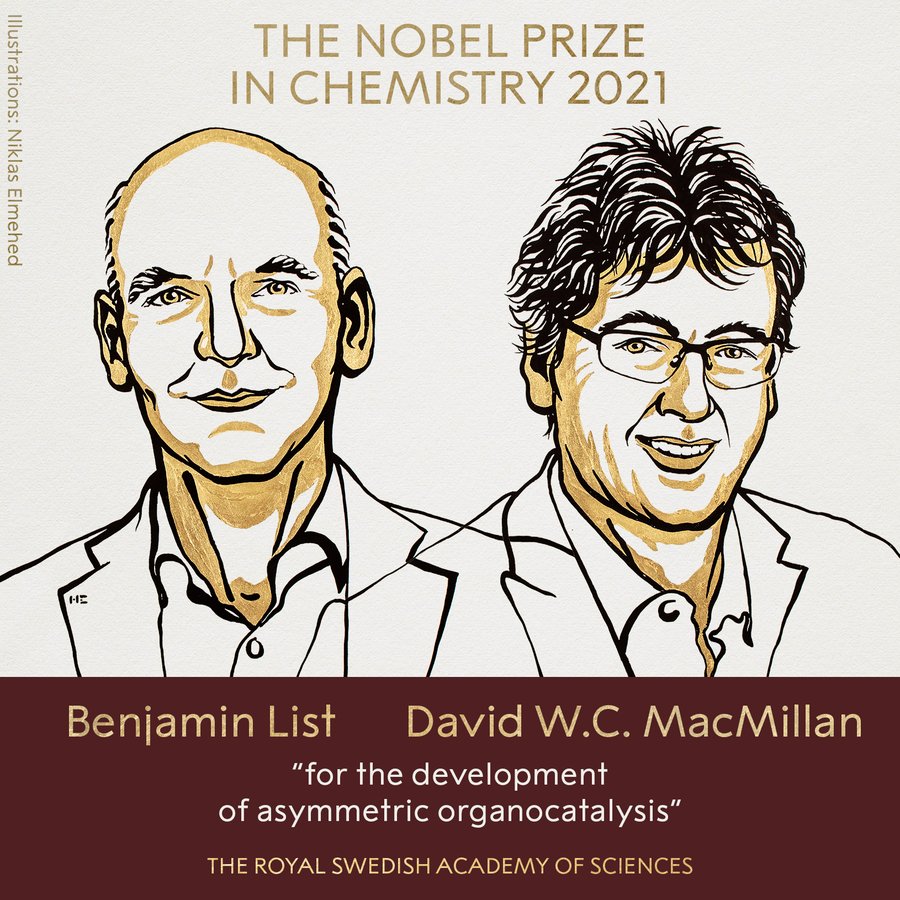
Premio Nobel de Química 2021


 El Premio Nobel de Química 2021

El Nobel de Química, anunciado este miércoles 6 de octubre, fue otorgado a los científicos a Benjamin List, científico alemán del Instituto Max Planck de Investigación del Carbón, y David W.C. MacMillan, investigador británico de la Universidad de Princeton (EE. UU.), «por el desarrollo de la organocatálisis asimétrica»

Los catalizadores son herramientas fundamentales para los químicos, pero los investigadores creyeron, durante mucho tiempo que, en principio, solo había dos tipos de catalizadores disponibles: los metales y las enzimas. Sin embargo, Benjamin List y David MacMillan desarrollaron en 2000, de forma independiente, un tercer tipo de catálisis, denominado «organocatálisis asimétrica», que se basa en pequeñas moléculas orgánicas.

Sus usos incluyen la investigación de nuevos productos farmacéuticos y también ha contribuido a que la química sea más ecológica, según la Real Academia de Ciencias sueca.

Press release: The Nobel Prize in Chemistry 2021

English
English (pdf)
Swedish
Swedish (pdf)

Logo

6 October 2021

The Royal Swedish Academy of Sciences has decided to award the Nobel Prize in Chemistry 2021 to

Benjamin List
Max-Planck-Institut für Kohlenforschung, Mülheim an der Ruhr, Germany

David W.C. MacMillan
Princeton University, USA

“for the development of asymmetric organocatalysis”


An ingenious tool for building molecules

Building molecules is a difficult art. Benjamin List and David MacMillan are awarded the Nobel Prize in Chemistry 2021 for their development of a precise new tool for molecular construction: organocatalysis. This has had a great impact on pharmaceutical research, and has made chemistry greener.

Many research areas and industries are dependent on chemists’ ability to construct molecules that can form elastic and durable materials, store energy in batteries or inhibit the progression of diseases. This work requires catalysts, which are substances that control and accelerate chemical reactions, without becoming part of the final product. For example, catalysts in cars transform toxic substances in exhaust fumes to harmless molecules. Our bodies also contain thousands of catalysts in the form of enzymes, which chisel out the molecules necessary for life.

Catalysts are thus fundamental tools for chemists, but researchers long believed that there were, in principle, just two types of catalysts available: metals and enzymes. Benjamin List and David MacMillan are awarded the Nobel Prize in Chemistry 2021 because in 2000 they, independent of each other, developed a third type of catalysis. It is called asymmetric organocatalysis and builds upon small organic molecules.

“This concept for catalysis is as simple as it is ingenious, and the fact is that many people have wondered why we didn’t think of it earlier,” says Johan Åqvist, who is chair of the Nobel Committee for Chemistry.

Organic catalysts have a stable framework of carbon atoms, to which more active chemical groups can attach. These often contain common elements such as oxygen, nitrogen, sulphur or phosphorus. This means that these catalysts are both environmentally friendly and cheap to produce.

The rapid expansion in the use of organic catalysts is primarily due to their ability to drive asymmetric catalysis. When molecules are being built, situations often occur where two different molecules can form, which – just like our hands – are each other’s mirror image. Chemists will often only want one of these, particularly when producing pharmaceuticals.

Organocatalysis has developed at an astounding speed since 2000. Benjamin List and David MacMillan remain leaders in the field, and have shown that organic catalysts can be used to drive multitudes of chemical reactions. Using these reactions, researchers can now more efficiently construct anything from new pharmaceuticals to molecules that can capture light in solar cells. In this way, organocatalysts are bringing the greatest benefit to humankind.

Illustrations

The illustrations are free to use for non-commercial purposes. Attribute ”© Johan Jarnestad/The Royal Swedish Academy of Sciences”

Illustration: Limonene molecules (pdf)
Illustration: Proline pdf)
Illustration: Organocatalyst (pdf)

Read more about this year’s prize

Popular science background: Their tools revolutionised the construction of molecules (pdf)
Scientific Background: Enamine and iminium ion-mediated organocatalysis (pdf)


Benjamin List, born 1968 in Frankfurt, Germany. Ph.D. 1997 from Goethe University Frankfurt, Germany. Director of the Max-Planck-Institut für Kohlenforschung, Mülheim an der Ruhr, Germany.

David W.C. MacMillan, born 1968 in Bellshill, UK. Ph.D. 1996 from University of California, Irvine, USA. Professor at Princeton University, USA.


Prize amount: 10 million Swedish kronor, to be shared equally between the Laureates.
Further information: www.kva.se and www.nobelprize.org
Press contact: Eva Nevelius, Press Secretary, +46 70 878 67 63, eva.nevelius@kva.se
Expert: Peter Somfai, +46 70 693 63 77, peter.somfai@chem.lu.se, the Nobel Committe for Chemistry


The Royal Swedish Academy of Sciences, founded in 1739, is an independent organisation whose overall objective is to promote the sciences and strengthen their influence in society. The Academy takes special responsibility for the natural sciences and mathematics, but endeavours to promote the exchange of ideas between various disciplines.

Nobel Prize® is a registered trademark of the Nobel Foundation.

To cite this section
MLA style: Press release: The Nobel Prize in Chemistry 2021. NobelPrize.org. Nobel Prize Outreach AB 2021. Sat. 9 Oct 2021. <https://www.nobelprize.org/prizes/chemistry/2021/press-release/>


Fuenrw https://www.nobelprize.org/prizes/chemistry/2021/prize-announcement/