Mostrando entradas con la etiqueta brain. Mostrar todas las entradas

sábado, 18 de diciembre de 2021

 El optimismo, al igual que la esperanza, significa tener una fuerte expectativa de que, en general las cosas irán bien a pesar de los contratiempos y de las frustraciones.Ahora bien, se puede ser optimista con tus alumnos o alumnas, o simplemente hacer como que se es optimista. Normalmente el que es optimista por naturaleza no tiene porque fingir serlo. Pero aún así, me permito darte unos consejos para mejorar tu optimismo dentro del aula. 


1. CAMINAR CON UNA POSTURA ERGUIDA. Hay una frase que aprendí hace años, del escritor francés Antoine de Saint-Exupéry, y desde entonces guía todos los actos de mi vida cotidiana. Esa frase es: "El mundo entero se aparta cuando ve pasar a un hombre (o mujer) que sabe a dónde va."

2. UTILIZA UNA VOZ ALEGRE. Recuerda que eres lo que transmites, si tu voz es de enfado, transmites una imagen poco educativa. No está mal hacer una bromita de vez en cuando en medio de la clase para limar asperezas. Realmente, si os cuento un secreto... yo incluso a veces llevo esos chistes apuntados en mi programación didáctica.

3. UTILIZA PALABRAS OPTIMISTAS Y MOTIVADORAS. La forma de decir las cosas muchas veces cambia el sentido de la oración. Yo siempre digo que no me gusta que me llamen raro, sino que digan que soy especial. ¿A que no parece lo mismo?

4. NO HABLES MAL DE NADIE. Los profesores somos personas como todas, no con todo el mundo te puedes llevar bien, pero al menos no demuestres que te llevas mal con alguien y menos si es un compañero de tu centro educativo.

5. ENFOCATE EN LAS SOLUCIONES NO EN LOS PROBLEMAS. Tus alumnos volvieron del recreo, y resulta que dos tuvieron un problema entre ellos (algo muy típico). Más que culpar el problema es mejor buscar una solución y si puede ser consensuada mediante el dialogo. De esta forma enseñamos que la solución es mucho más importante que el propio problema.

6. PIENSA QUE LOS PROBLEMAS TE AYUDAN A CRECER. Una cosa siempre esta clara, si tu aprendes ante una nueva situación, tus alumnos también. Por lo tanto, de la solución buscada a un problema, aprendemos. Las adversidades nos vuelven fuerte si somos optimistas.

7. SÉ UN MODELO A SEGUIR PORQUE TE EXIGE SER MEJOR. Normalmente cuando tomamos apuntes para nosotros mismos, lo hacemos de una forma más sucia que si sabemos que alguien nos va a ver lo que hemos escrito. Eso puede llevarse a todas las escenas de la vida. En el aula debes saber siempre que eres el ejemplo a seguir, si eso no se te olvida, no me cabe duda que te exigirás ser mejor antes tus alumnos incluso ante aspectos que en tu vida personal te producen temor. ¿Cuantas veces has matado a un insecto dentro del aula y cuando estas en tu casa pides a alguien que lo haga por ti?

8. EL SER OPTIMISTA REQUIERE DE CONSTANCIA Y ENTRENAMIENTO. Lógicamente, todo lo dicho anteriormente no es válido sin esfuerzo, pero todo entrenamiento nos lleva a un aprendizaje invisible que se acaba convirtiendo en rutina. 

What is Inquiry-Based Learning?

 This video is about Inquiry-Based Learning.

In The Order of Phoenix, the fifth of the Harry Potter series, Dolorus Umbridge takes over as the Defense Against the Dark Arts teacher and instantly transforms the class into a textbook-based class focused on passing the standardized tests. When Harry questions whether this will prepare them for the chaos of fighting against Vold . . . err . . . um . . . he who must not be named . . . Umbridge punishes him and he ends up forming his own school within a school called Dumbledore’s Army. Dumbledore’s Army is purely inquiry-based. While Harry is the teacher, he is mostly a guide on the side, empowering the students to ask questions and find the answers themselves. They rely on each other and on various spell books to solve problems and answer their questions. While the process might seem messy compared to Umbridge’s approach, the students learn at a rapid pace because they aren’t wasting time repeating what they already know. This is an example of inquiry-based learning. Although since it takes place in the UK, it’s probably enquiry-based learning. History of Inquiry-Based Learning Inquiry-based learning has existed for thousands of years. Socrates and Confucius both used variations on an inquiry-based format. It’s a critical component of the scientific method of the early enlightenment and it was a core idea within both Dewey and Montessori’s notions of student-centered learning. Pedaste shares a model of the four phases of inquiry. It starts with orientation, which is often a discussion. From there, it moves into conceptualization, where students generate questions and define a hypothesis. This leads to investigation, where students explore, experiment, and interpret data, often in a way that is flexible and dynamic. Finally, they move into a a conclusion. Heather Banchi and Randy Bell define four different types of inquiry that you can view on a spectrum from teacher-centered / structured to learner-centered / open. Level 1 is Confirmation Inquiry, where the teacher teachers the concepts, creates the questions, and models the process for students. Level 2: is Structured Inquiry, where the teacher creates the initial questions and shares the procedures then walk through the rest of the inquiry process by collecting and analyzing data and drawing conclusions. Level 3 is Guided Inquiry, where the teacher provides the research questions but students own the research or experimentation process. Level 4 is Open/True Inquiry. Here students formulate their own questions, design their own experiments or research, collect their own data, and share their findings. According to Banchi and Bell, teachers should start with levels 1 and 2 and use those as scaffolding, so that students can learn the inquiry process. Here are a few places you can start with inquiry-based learning. In language arts or social studies, you can do a wonder-day or wonder week project, where students develop their own questions and move through the inquiry process. You can also do a Genius Hour project, where students not only ask their own questions but design their own product as a result. In math, you can have students explore a concept and develop their own problems. And in science, you could do a science fair project or a myth-buster style approach to testing an urban legend. If we want students to own their learning, we need them to remain curious. And this is why inquiry-based learning is so valuable. SOURCES: National Institute for Health. (2005). Doing Science: The Process of Science Inquiry. http://science.education.nih.gov/supp... Bell, T.; Urhahne, D.; Schanze, S.; Ploetzner, R. (2010). "Collaborative inquiry learning: Models, tools, and challenges". International Journal of Science Education. 3 (1): 349–377. Bibcode:2010IJSEd..32..349B. Bruner, J. S. (1961). "The act of discovery". Harvard Educational Review 31 (1): 21–32. *Note that this is a great work from Bruner, who is one of my favorite theorists
MOSTRAR MENOS

viernes, 17 de diciembre de 2021

Teaching Self-Regulation by Modeling

 When teachers explicitly recognize and respond to their emotions in class, students learn to engage in these processes themselves.

Our How Learning Happens video series explores teaching practices grounded in the science of learning and human development. To see more, visit http://www.edutopia.org/how-learning-... This series was produced by Edutopia in collaboration with the National Commission on Social, Emotional, and Academic Development (https://www.aspeninstitute.org/progra...), with support from the Chan Zuckerberg Initiative (https://chanzuckerberg.com/). Special Thanks: The Science of Learning and Development Initiative Turnaround for Children: https://www.turnaroundusa.org/ Learning Policy Institute: https://learningpolicyinstitute.org/ American Institutes for Research: https://www.air.org/ EducationCounsel: http://educationcounsel.com/
MOSTRAR MENOS

domingo, 8 de marzo de 2020

La experiencia de una vida en 3 centímetros.

Una investigación confirma que los estados afectivos son también procesos cognitivos

Todas las emociones de nuestra vida están recogidas en una región cerebral de tres centímetros de diámetro, la misma que procesa la información sensorial, los estados extracorporales y las decisiones éticas: los estados afectivos son también procesos cognitivos.

Ilustración de cómo se representan las emociones en el cerebro según los hallazgos del estudio. Crédito: Luca Cecchetti, IMT School for Advanced Studies Lucca.
Toda la experiencia emocional de nuestra vida está recogida en una región de nuestro cerebro de tres centímetros de diámetro, han descubierto científicos del Laboratorio de Mente Molecular (MoMi Lab), perteneciente a la Escuela de Estudios Superiores IMT de Lucca, en la Toscana italiana. Usamos las emociones para descifrar cascadas complejas de eventos internos.

 Son un potencial natural que registra nuestra reacción a las diferentes experiencias de la vida, aunque nunca ha estado muy claro cómo el cerebro procesa los estados afectivos. En 2017 se descubrió que nuestro mundo emocional es mucho más rico y sutil de lo que creíamos, ya que tenemos al menos 27 emociones y no seis, como se había creído hasta entonces. Además, las emociones se pueden reflejar en un mapa interactivo multidimensional para ilustrar la forma en que están conectadas entre sí.

 La nueva investigación ha conseguido identificar ahora que cuando sentimos alegría, enfado, tristeza, euforia o melancolía, entre otras emociones, el cerebro procesa la experiencia a través de una pequeña región de la corteza llamada unión tempo-parietal. Se trata de una región que se difumina en la frontera de los lóbulos temporal y parietal y que es la que procesa la información procedente de los sistemas visual, auditivo y somatosensorial, relacionado con el tacto, la temperatura, la propiocepción (posición del cuerpo) y la nocicepción (dolor). 

 Esa región también está relacionada con las decisiones éticas que tomamos y con la ilusión de experiencias extracorporales, así como con la capacidad de atribuir pensamientos e intenciones a otras personas. Según la nueva investigación, esta región cerebral también es capaz de representar topográficamente la complejidad de lo que sentimos: qué emociones sentimos en un momento preciso y cuán intensamente las percibimos. El mecanismo implicado en el procesamiento de las emociones es el mismo que usa el cerebro para procesar funciones básicas como la vista, el oído, el olfato, el gusto, el tacto. Por esta razón, los investigadores proponen la definición de emototopía como el principio de codificación de emociones en el cerebro. 

  Emoción cognitiva Este descubrimiento tiene un efecto más profundo que la mera localización del área cerebral de las emociones. La ciencia afectiva está considerando en la actualidad que las emociones no constituyen procesos aislados que ocurren al margen del resto de la actividad mental de la persona. Por el contrario, establece que la dinámica emocional está implicada en otros procesos de índole cognitiva como la atención, la memoria o la toma de decisiones. La nueva investigación confirma que las emociones no son algo diferente de los procesos cognitivos, ya que los procesos cerebrales que rigen la percepción de las emociones son los mismos que procesan la información de los sentidos.

 Eso significa que el proceso cognitivo que nos permite interpretar nuestro entorno a través de los estímulos que proceden de los sentidos, es el mismo que usamos para procesar las emociones. Este descubrimiento es significativo porque la percepción sensorial es algo objetivo, basado en estímulos procedentes del mundo exterior, mientras que las emociones son estados subjetivos que tienen consecuencias biológicas.

 Para el cerebro, ambos procesos son análogos. Descubrir que ambos procesos forman parte de la cognición aporta nuevos elementos que ayudan comprender mejor cómo los procesos emocionales influyen en el estado de salud, algo que ocurre por ejemplo en el caso de la depresión, claro ejemplo de cómo una emoción (la tristeza) deriva en un trastorno mental.

martes, 22 de agosto de 2017

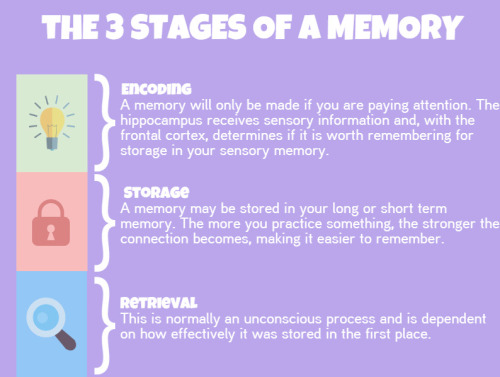
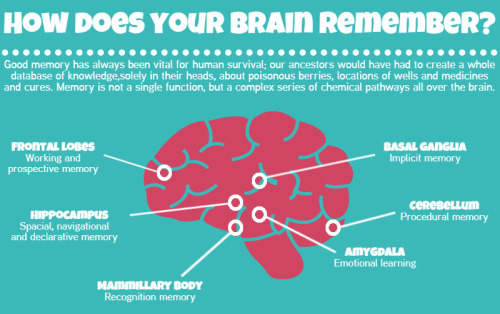
The 3 stages of a memory(II)

Been away for a while to focus on exams, so I thought memory was a relevant topic to explore! This graphic shows where and how it works and also tips on improving your memory.
(vía tobeagenius)

sábado, 23 de mayo de 2015

Brain Tricks - This Is How Your Brain Works

Ever wonder how your brain processes information? These brain tricks and illusions help to demonstrate the two main systems of Fast and Slow Thinking in your brain. 

Written and created by Mitchell Moffit (twitter @mitchellmoffit) and Gregory Brown (twitter @whalewatchmeplz).

TWITTER: http://www.twitter.com/AsapSCIENCE
FACEBOOK: http://www.facebook.com/AsapSCIENCE

miércoles, 20 de mayo de 2015

How does your brain respond to pain? - Karen D. Davis

Everyone experiences pain -- but why do some people react to the same painful stimulus in different ways? And what exactly is pain, anyway? Karen D. Davis walks you through your brain on pain, illuminating why the "pain experience" differs from person to person. 

Lesson by Karen D. Davis, animation by Brett Underhill.

martes, 24 de febrero de 2015

We Are Built To Be Kind.

Greed is good. War is inevitable. Whether in political theory or popular culture, human nature is often portrayed as selfish and power hungry. UC Berkeley psychologist Dacher Keltner challenges this notion of human nature and seeks to better understand why we evolved pro-social emotions like empathy, compassion and gratitude.

We've all heard the phrase 'survival of the fittest', born from the Darwinian theory of natural selection. Keltner adds nuance to this concept by delving deeper into Darwin's idea that sympathy is one of the strongest human instincts — sometimes stronger than self-interest.

FEATURING: Dacher Keltner, professor of psychology and founding faculty director of the Greater Good Science Center at UC Berkeley