The Royal Swedish Academy of Sciences has decided to award the Nobel Prize in Physics 2016 with one half to
David J. Thouless
University of Washington, Seattle, WA, USA
University of Washington, Seattle, WA, USA
and the other half to
F. Duncan M. Haldane
Princeton University, NJ, USA
Princeton University, NJ, USA
and
J. Michael Kosterlitz
Brown University, Providence, RI, USA
Brown University, Providence, RI, USA
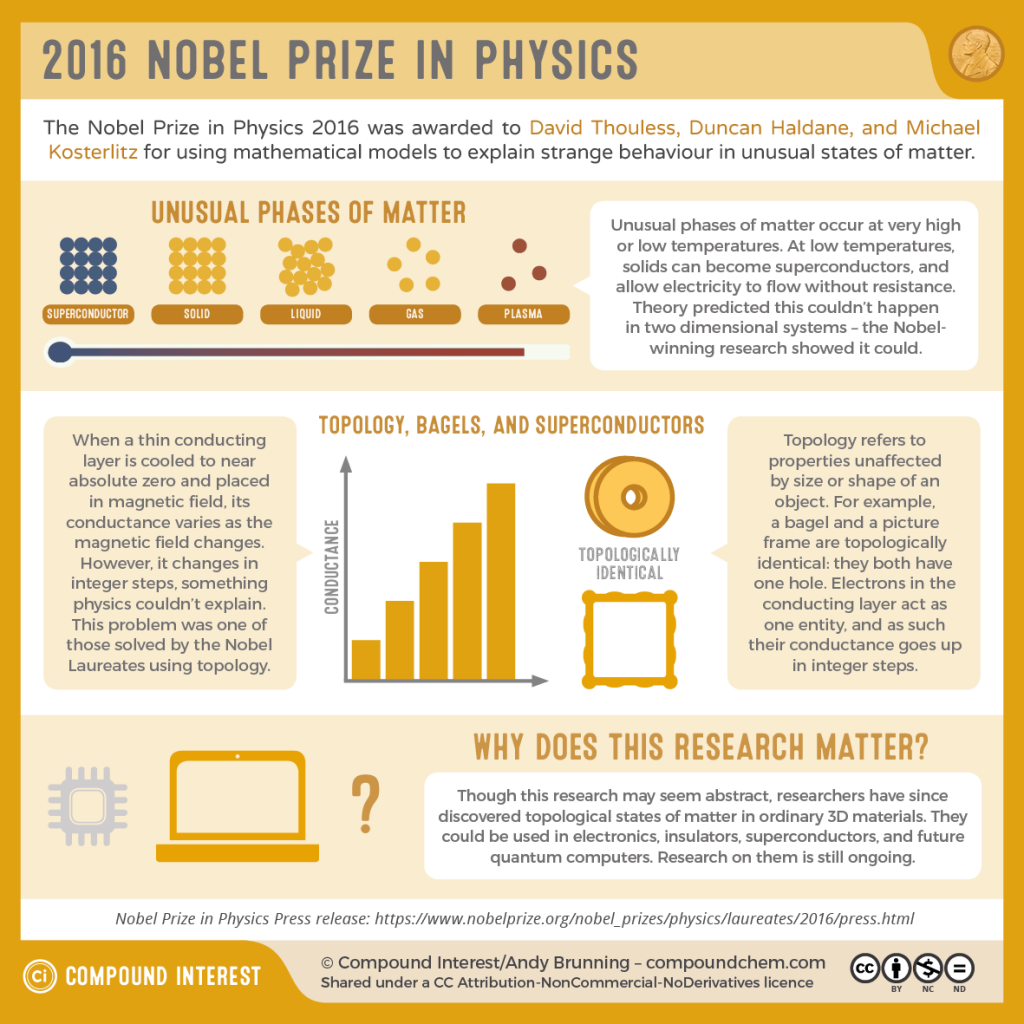
”for theoretical discoveries of topological phase transitions and topological phases of matter”
They revealed the secrets of exotic matter
This year’s Laureates opened the door on an unknown world where matter can assume strange states. They have used advanced mathematical methods to study unusual phases, or states, of matter, such as superconductors, superfluids or thin magnetic films. Thanks to their pioneering work, the hunt is now on for new and exotic phases of matter. Many people are hopeful of future applications in both materials science and electronics.
The three Laureates’ use of topological concepts in physics was decisive for their discoveries. Topology is a branch of mathematics that describes properties that only change step-wise. Using topology as a tool, they were able to astound the experts. In the early 1970s, Michael Kosterlitz and David Thouless overturned the then current theory that superconductivity or suprafluidity could not occur in thin layers. They demonstrated that superconductivity could occur at low temperatures and also explained the mechanism, phase transition, that makes superconductivity disappear at higher temperatures.
In the 1980s, Thouless was able to explain a previous experiment with very thin electrically conducting layers in which conductance was precisely measured as integer steps. He showed that these integers were topological in their nature. At around the same time, Duncan Haldane discovered how topological concepts can be used to understand the properties of chains of small magnets found in some materials.
We now know of many topological phases, not only in thin layers and threads, but also in ordinary three-dimensional materials. Over the last decade, this area has boosted frontline research in condensed matter physics, not least because of the hope that topological materials could be used in new generations of electronics and superconductors, or in future quantum computers. Current research is revealing the secrets of matter in the exotic worlds discovered by this year’s Nobel Laureates.
Read more about this year's prize
To read the text you need Acrobat Reader.
All illustrations: Copyright © Johan Jarnestad/The Royal Swedish Academy of Sciences
David J. Thouless, born 1934 in Bearsden, UK. Ph.D. 1958 from Cornell University, Ithaca, NY, USA. Emeritus Professor at the University of Washington, Seattle, WA, USA.
https://sharepoint.washington.edu/phys/people/Pages/view-person.aspx?pid=85
https://sharepoint.washington.edu/phys/people/Pages/view-person.aspx?pid=85
F. Duncan M. Haldane, born 1951 in London, UK. Ph.D. 1978 from Cambridge University, UK. Eugene Higgins Professor of Physics at Princeton University, NJ, USA.
https://www.princeton.edu/physics/people/display_person.xml?netid=haldane&display=faculty
https://www.princeton.edu/physics/people/display_person.xml?netid=haldane&display=faculty
J. Michael Kosterlitz, born 1942 in Aberdeen, UK. Ph.D. 1969 from Oxford University, UK. Harrison E. Farnsworth Professor of Physics at Brown University, Providence, RI, USA.
https://vivo.brown.edu/display/jkosterl
https://vivo.brown.edu/display/jkosterl
Prize amount: 8 million Swedish krona, with one half to David Thouless and the other half to be shared between Duncan Haldane and Michael Kosterlitz.
Further information: http://kva.se and http://nobelprize.org
Press contact: Jessica Balksjö Nannini, Press Officer, phone +46 8 673 95 44, +46 70 673 96 50, jessica.balksjo@kva.se
Experts: Thors Hans Hansson, phone +46 8 553 787 37, hansson@fysik.su.se, and David Haviland, haviland@kth.se, members of the Nobel Committee for Physics.
Further information: http://kva.se and http://nobelprize.org
Press contact: Jessica Balksjö Nannini, Press Officer, phone +46 8 673 95 44, +46 70 673 96 50, jessica.balksjo@kva.se
Experts: Thors Hans Hansson, phone +46 8 553 787 37, hansson@fysik.su.se, and David Haviland, haviland@kth.se, members of the Nobel Committee for Physics.